Welcome, traveler.
You've found the digital vardo.
📡 📶 🛰️ LIVE MESH NETWORK — ACTIVE SCAN IN PROGRESS 🛰️ 📶 📡
No cell towers. Just radios, nodes, and figuring it out the hard way.
→ View Live Mesh Activity & Node Mapping ←
(signal is out there — we’re finding it)
|
Navigation
:: The Homestead {Pa's Domain} :: Geocaching Adventures {Ma's Domain} :: Gaming Nights {Evelyn's Domain} :: Vardo Family Project {Family Domain} :: Squirreladillo Lore {Family Domain} :: About the MisFits {Family Domain} :: Guestbook ~ Sign It! :: 88x31 Button Wall :: Links Out Trailhead status: thumbtacks secure, coffee warm, bulletin board slightly haunted. |
This is the front porch bulletin board for the digital vardo. Big stories live on their own pages when they need the room. Everything else gets pinned up here first so folks can look around without having to chew through a dictionary. :: Older logs / archaeology mode → 
Click the picture to follow the Key-Whatley Cemetery cleanup mission. July 17–18, 2026 — Family Came Back Ma and Pa loaded the Jeep, Vardo, four-wheeler, tools, and enough equipment to resemble a small expeditionary force, then headed deep into Kisatchie National Forest to reclaim Jackie’s family cemetery from the Louisiana woods. The mission included rough forest roads, fallen trees, heavy brush, graves carefully cleared by hand, Ma personally arguing with a chain-link fence, and one brutally hot night after the Vardo air conditioner surrendered. 
Click the picture to read the shed recovery quest. May 8–9, 2026 — Reduce, Reuse, ♻️ Recycle An abandoned shed left behind after Hurricane Harvey got one more chance at usefulness. Pa tore it down, Ma came in like a tall Valkyrie for the roof work, and the whole thing came home by trailer, leverage, straps, and stubbornness. May 2, 2026 The MisFits made a woods-and-weirdness run to Whispering Grove Faire in Kountze, Texas — complete with fire performers, knife throwing, gnome diplomacy, and Evelyn helping Stormeigh see over the crowd the Lee-family way. It turned into exactly the kind of day worth saving: pine trees, handmade faire chaos, rogue training jokes, Ma keeping the orbit steady, Pa finding the gnome jokes, and the girls making another memory out in the middle of it all. 
Click the faire collage to read the full Whispering Grove Faire field log. :: Read the Full Whispering Grove Faire Story :: April 2026 ~ Beach Weekend, Vardo Style Ma and I slipped away to the beach for the weekend and spent a little time hanging out with our adult friends, enjoying the sand, the Gulf air, and a rare stretch of grown-up breathing room while the kiddo was elsewhere doing kiddo things. Naturally, because this is us, “relaxing at the beach” still somehow involved the Vardo, the Jeep, the four-wheeler, a pile of beach gear, and me experimenting with Meshtastic signals using the Vardo and a push-up antenna pole. Some folks go to the beach and read a book. I go to the beach and start wondering how far a little radio node can holler across the coast. 
The Jeep, the Vardo, the beach, and a little antenna reaching up like it had something important to say. 
A rare kid-free beach pause with Ma, the Vardo close by, and absolutely no shortage of sand, sun, or mischief. 
From driveway chaos to beach camp setup, this is pretty much what SETX MisFits looks like when it escapes to the coast. April 27, 2026 ~ Rural Kid GPS Evie got off the bus today and immediately started explaining how our road works like she had just discovered a secret navigation system hidden in plain sight. According to her, she does not need GPS to know when she is almost home. She just has to wait for the bus to hit the rough straightaway. In other words, rural kids do not use satellites. They use potholes, road bumps, weird landmarks, and whatever mysterious brain-map gets installed after enough rides down the same country road. The best part is... she is not wrong. Out here, directions have always been a little different. You do not say, "watch for the GPS pin." You say things like, "when the road starts beating the kidneys out of you, you're getting close." And if that fails, there is always the giant LEE in the grass. Because apparently our neighborhood came with its own map label. 
Evie unlocked the overworld map. 
Actual rural kid GPS marker. No subscription required. 
Somewhere down there is a school bus full of kids learning terrain-based navigation. So there it is. Modern kids have phones, maps, and location sharing. Evie has a straightaway full of potholes and enough road-memory to know when she is almost home with her eyes closed. No signal required. Just don't miss the bumps. April 10–12, 2026 ~ Pleasant Hill Run (Louisiana) This one turned into a full-on Louisiana run — battlefield dust, backroads, small towns, and a whole lot of finds. Started as a trip to watch the Battle of Pleasant Hill and turned into one of our favorite adventures yet. 
Click the image or here to view the full Pleasant Hill Run page. April 8, 2026 ~ Rail Ties, Escape Artists, and Parking Lot Chaos
Recovered a few more old rail ties for future projects around the homestead. Those things are no joke — heavy, awkward, and absolutely determined to remind you why staying in shape matters.
Meanwhile, we have got a daily situation developing with one particular chicken. Out of the whole flock, there is exactly one that has decided the rules do not apply to her.
And just to round things out, Ma has taken it upon herself to upgrade the Honda Fit into a rolling work of art — specifically designed to cause maximum embarrassment in the school pickup line.
March 8, 2026 ~ 20th Anniversary Pre-Trip Inspection
Sunday was final-prep day for our upcoming 20th anniversary family vacation.
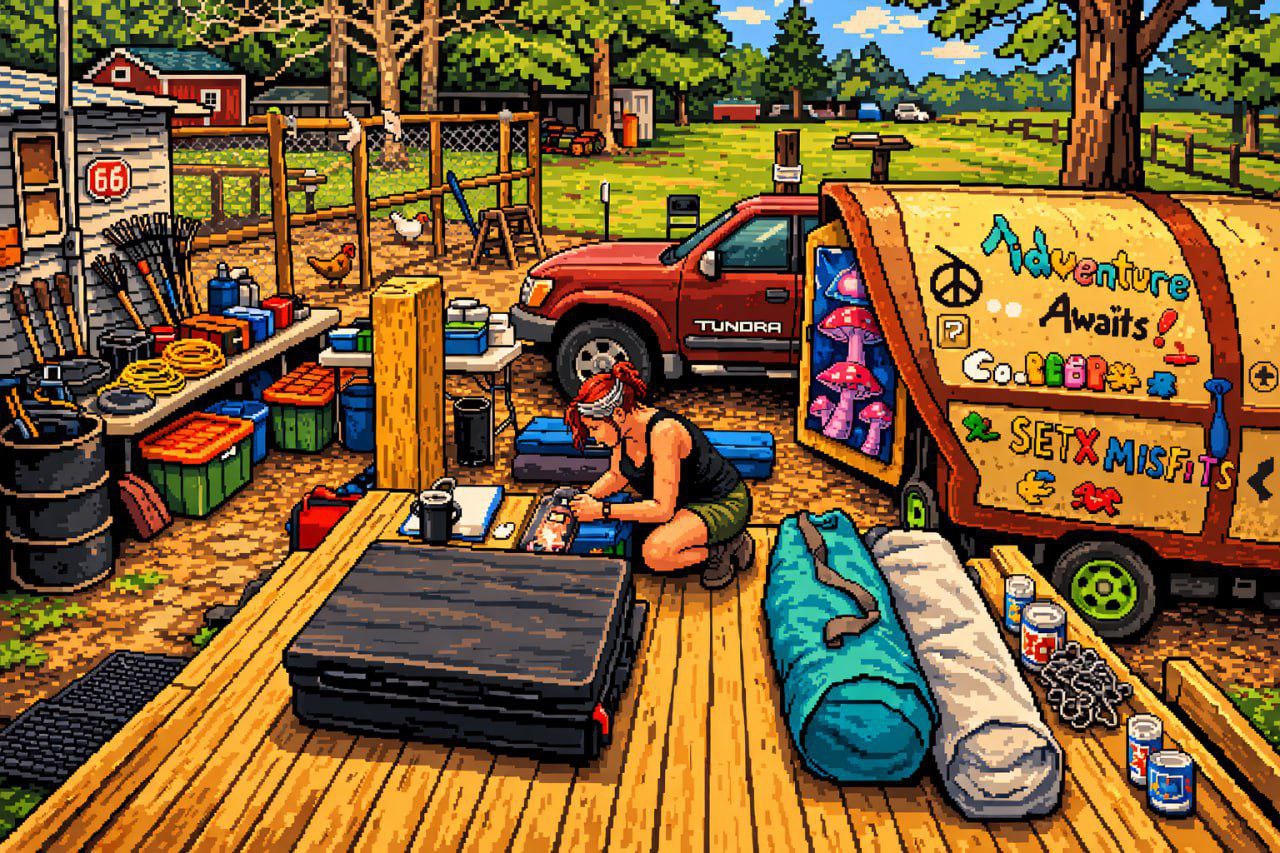
On the Vardo side of the operation, Ma and Evelyn had the inside spread out, sorted, and brought back under control. Gear got checked, supplies got counted, and the usual rolling-cabin chaos got turned back into something roadworthy. It was one of those real behind-the-scenes prep days that never looks glamorous, but makes the whole trip possible.
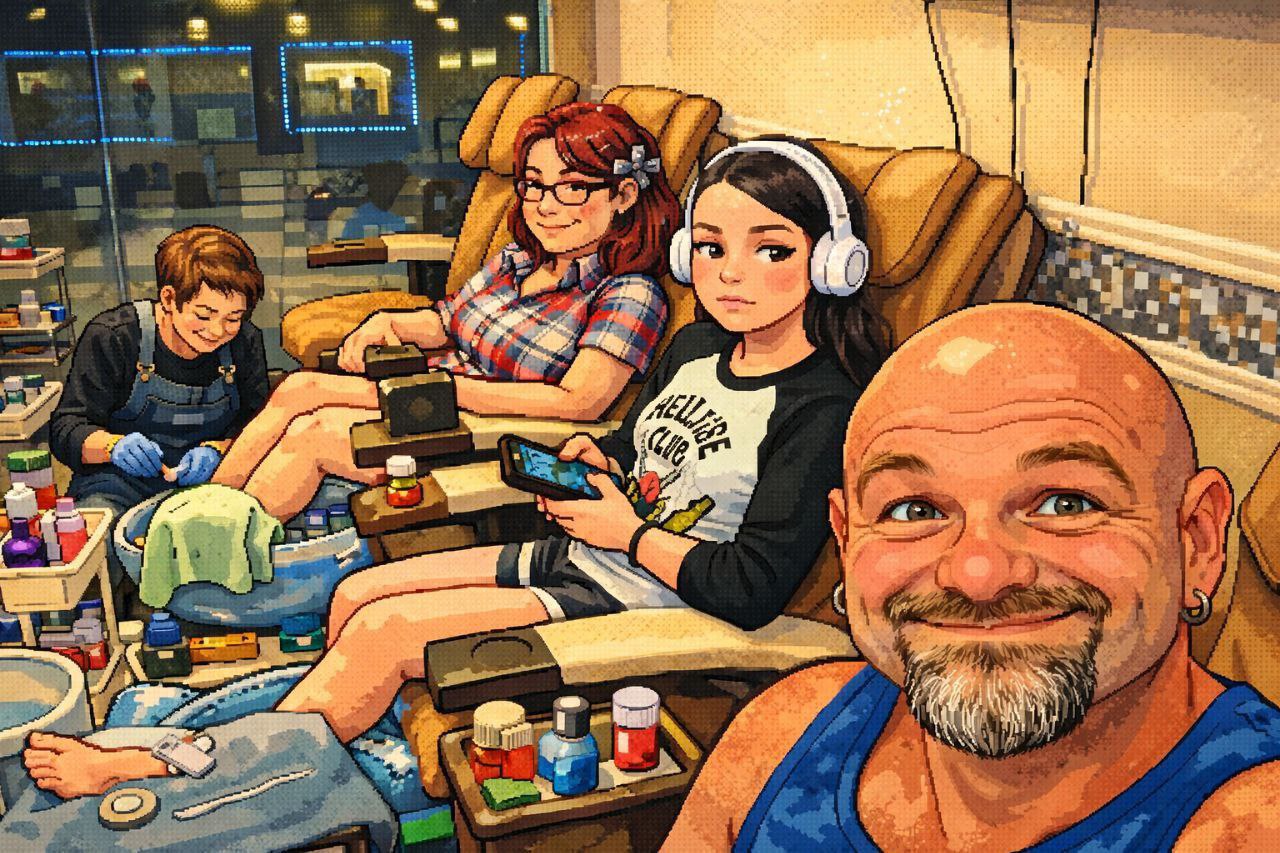
After all that, we called the heavy lifting done and treated ourselves to a little bit of pampering at the nail salon.
March 6, 2026 ~ Chalkboard Social Network I've been experimenting with something that feels a whole lot more real than scrolling: writing a question on the gym chalkboard and letting whoever wants to answer, answer. I put this one up a few days earlier, and by the time I snapped the follow-up, this was round three and by far the most people had joined in so far. Turns out if you give folks a real question and a little room to write, they will still show up. That feels a lot more like social media than most social media does.
March 2026 ~ Dad + Eve Motorcycle School Ride
One of those quiet little legacy days that matters more later than it does in the moment: Dad and Eve rode to school together, turning an ordinary morning into a memory worth hanging onto. Short ride. Big meaning. Full story lives on its own page.
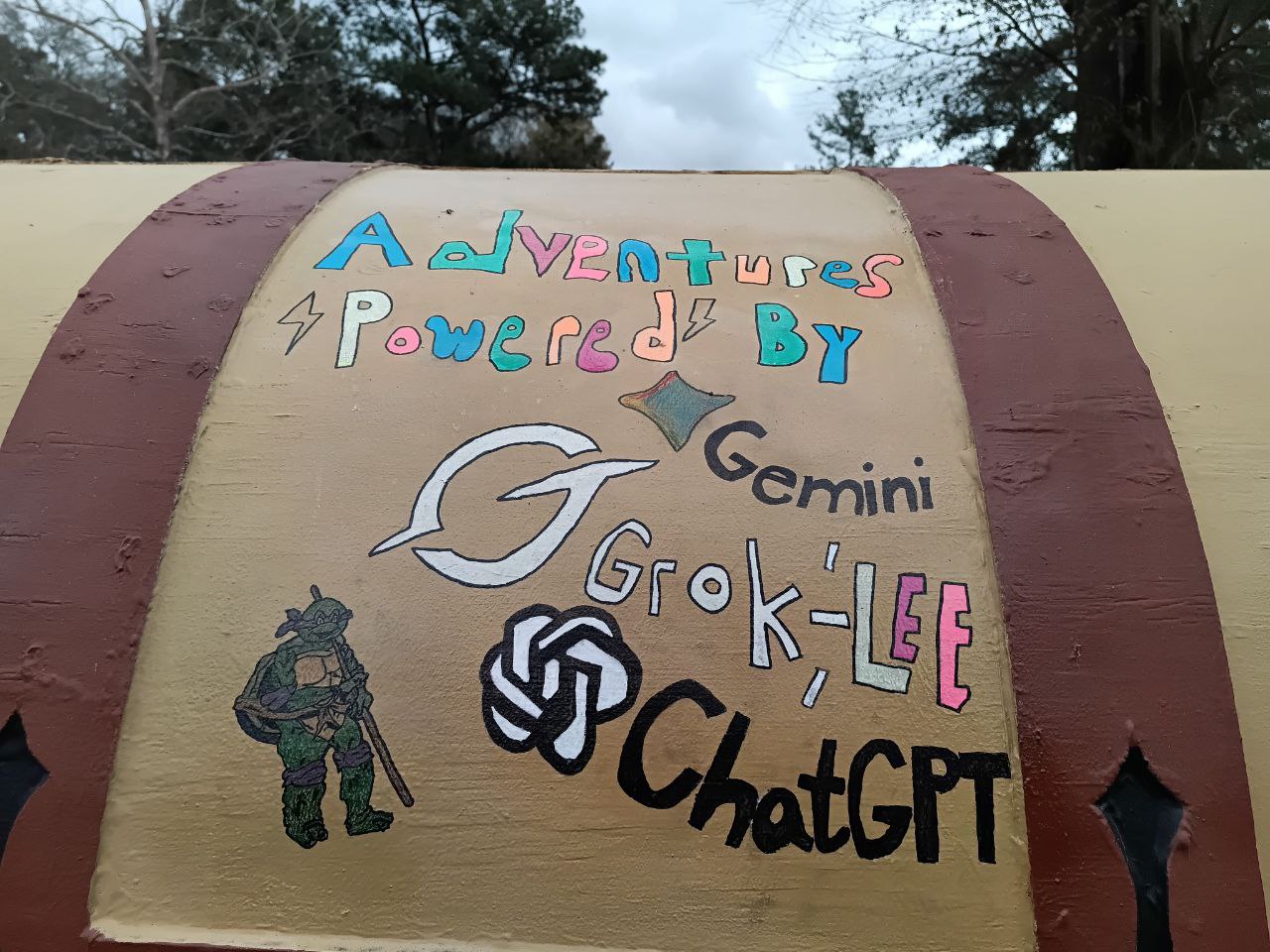
February 28, 2026 ~ Cryptid Support Specialists Turns out the MisFits have quietly built a whole digital pit crew. We use AI to help plan vacations, sort out homestead ideas, untangle website rebuilds, and keep family projects moving when the brain is tired but the work still needs doing. It is not replacing the real life part of any of this. It just helps us haul the map, the notebook, and the extra flashlight. Weird little future goblins, but useful.
February 21, 2026 ~ Birds Eye View of the MisFit Farms A few aerial shots of the homestead work core as it stood in late February. Nothing glamorous. Just the real map: house, chicken yard, sheds, vehicles, work zones, and the lived-in shape of the place where a lot of our projects begin. Sometimes it helps to step back and look at the whole board before the next round of repairs, plans, and bad ideas gets underway.
February 14, 2026 ~ The Houston Raid
Valentine's weekend took a hard left into MisFits territory: family convoy, scavenging, supplies, thrift-store victories, and a proper war chest hauled back east. Too much happened to leave buried on the front page, so the whole expedition got its own chronicle page.
|

.jpg)
.jpg)





Bulletin board rebuilt. Thumbtacks holding. Vardo spirits appeased for now.